

Golden Squares · Rainbow · Coins / Clover / Pot
LE GAMES MECHANICS · GOLDEN SQUARES
Golden Squares in Le Games: how Hacksaw changes one mechanic from slot to slot
From the straightforward Golden Squares in Le Bandit to Buckets, Jackpot Markers and Position Multipliers — what stays familiar and what Hacksaw rebuilds in each version.
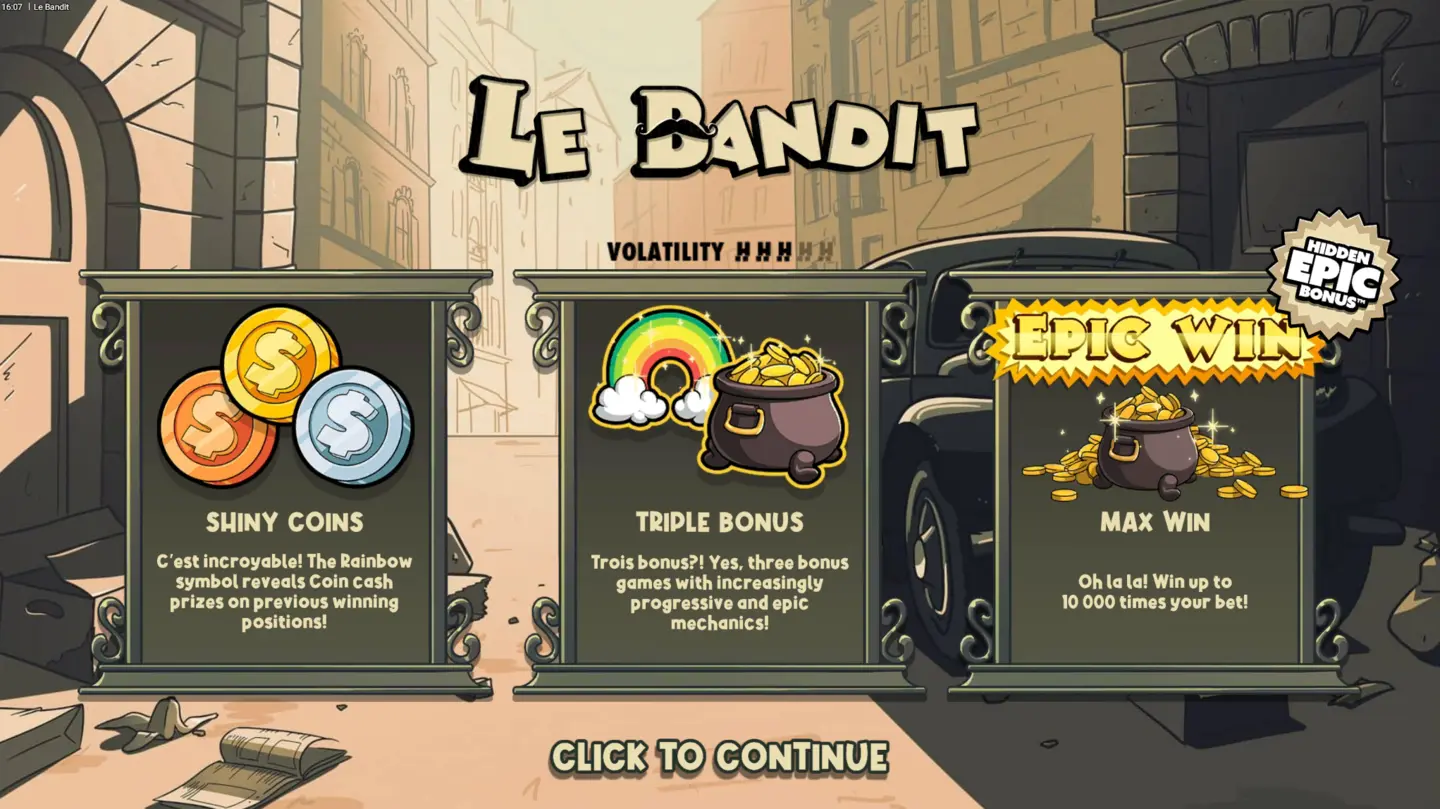
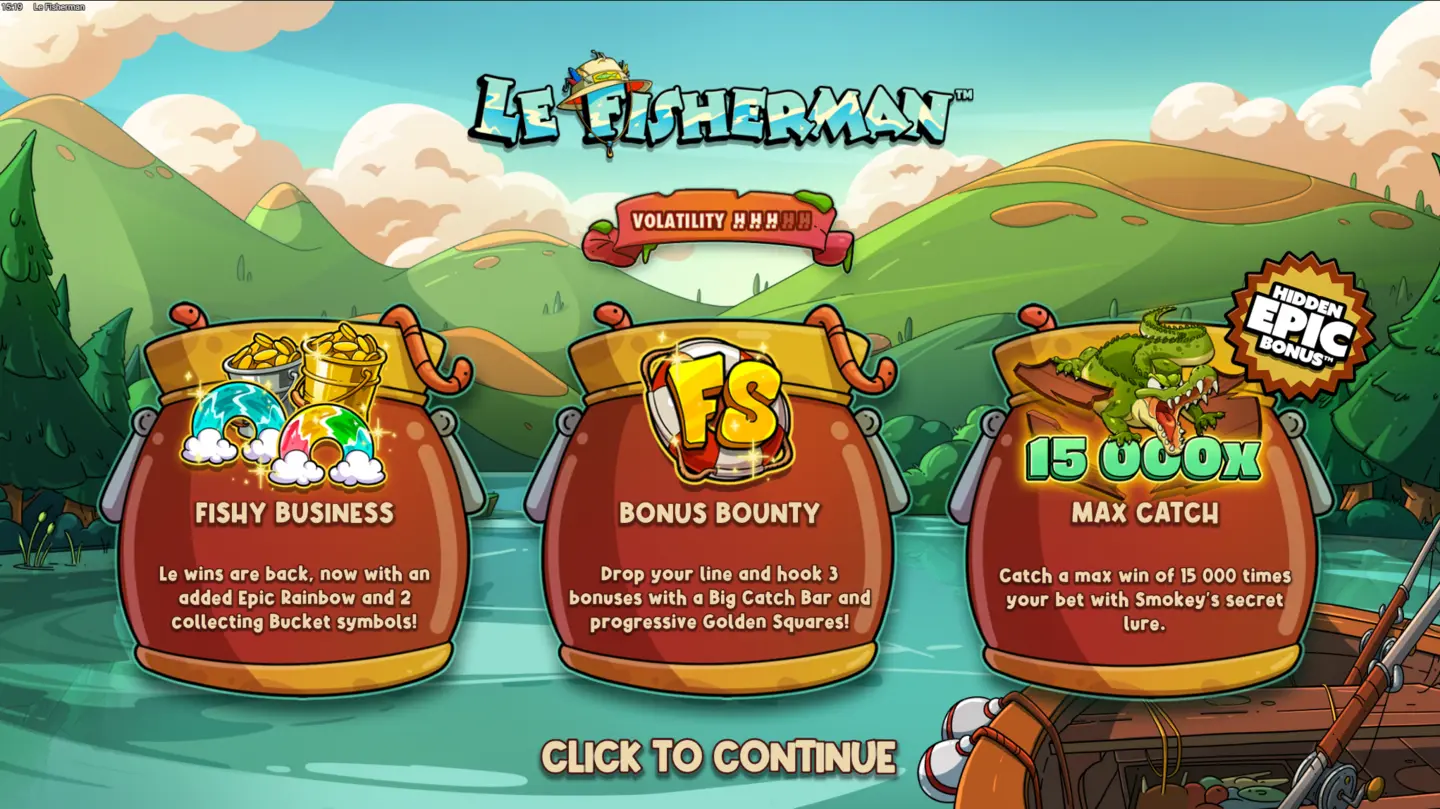
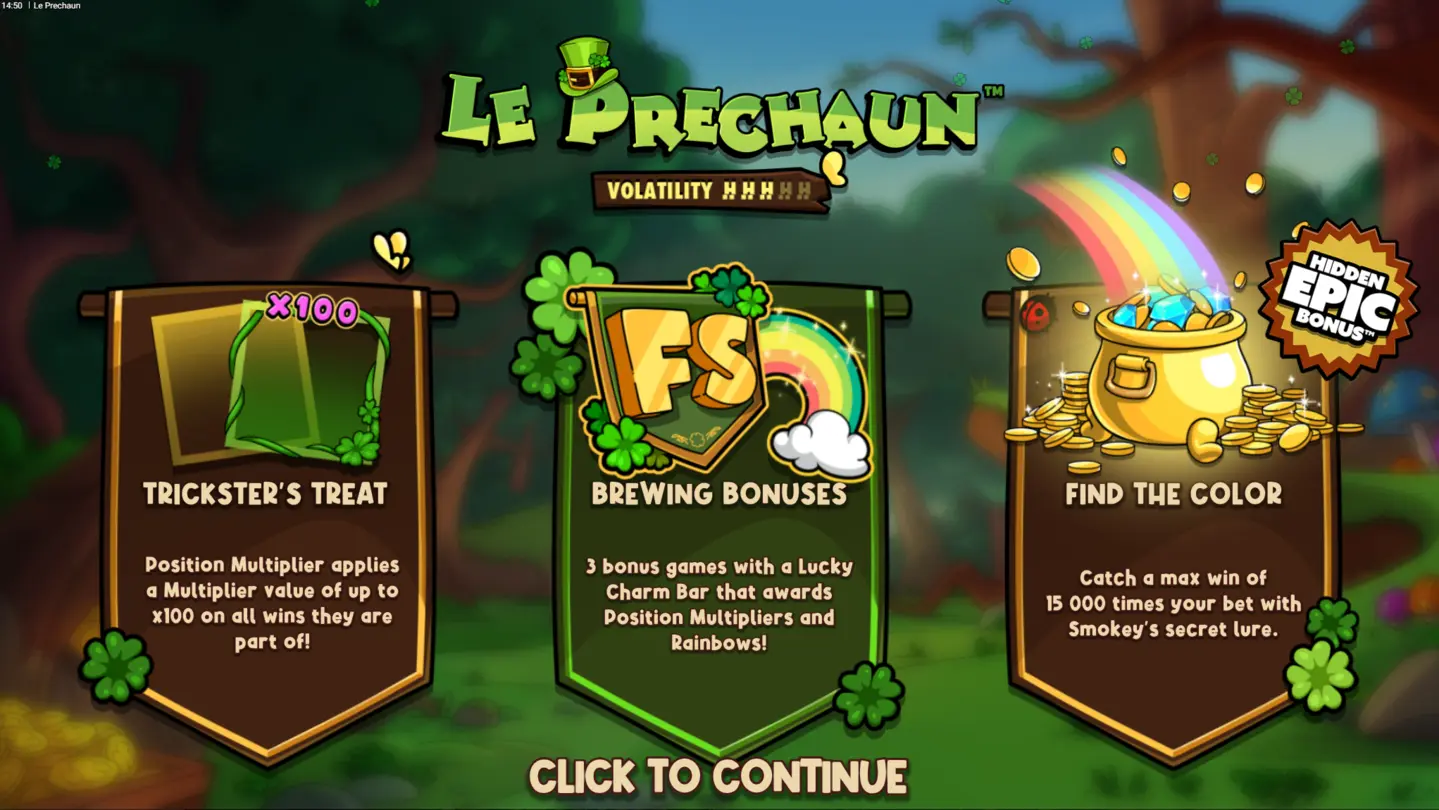
Play Le Bandit a few times and the Golden Squares loop is easy to remember. A winning cluster uses a position, that position becomes golden, and a Rainbow can later activate the marked cells to reveal Coins, Clover or a Pot of Gold.
It looks like a mechanic that could simply be copied into the next game. Hacksaw Gaming did the opposite. Le King adds Treasure Pots and Jackpot Markers. Le Santa introduces Santa Sacks and Jackpot Boxes. Le Fisherman turns collectors into a local-versus-global system built around Buckets. Le Prechaun adds Position Multipliers that give individual cells a memory of their own.
The name Golden Squares therefore stays familiar while the job of the mechanic changes. We compared seven Le Games in which marked or Golden Squares are a central part of play and used the same questions for each one: how is a square created, what activates it, what can appear inside it, and what new layer does the game add?
Golden Squares are only one branch of the larger Le universe. For the full collection, see our guide to all Le Games. RTP, maximum win and volatility are covered separately in our Le Games comparison; this page is deliberately about what happens on the grid.
Golden Squares in 30 seconds
The basic loop is simple: a win marks a position, the Golden Square stores that state, and a Rainbow moves the prepared cells into an active phase. The reveal can then lead to collecting, multiplying, a jackpot branch or another game-specific effect. That is the shared framework, not a rigid rule: Hacksaw changes the contents of the squares, the collectors, Rainbow behaviour and how long a position remains relevant.
Anatomy of a Golden Square
01WIN
02POSITION MARKED
03GOLDEN SQUARE
04RAINBOW
05SPECIAL SYMBOL
06COLLECT / MULTIPLY / JACKPOT
How we compared the games
We used the game rules and looked only at the Golden Squares system: how a cell is created, how it is activated, which special symbols can be revealed, how collectors interact and what changes in bonus modes. RTP and Max Win are intentionally left out so this remains a mechanics comparison rather than a ranking.
Contents
What Golden Squares actually do
A Golden Square is a grid position that keeps an extra state after an earlier event. In the classic Le branch, that event is usually a win. Paying symbols disappear during the cascade, while the cells used by the win remain marked. Visually the change is small; mechanically the grid now remembers something that happened before.
A second trigger is then required, most often a Rainbow. It activates the prepared positions and reveals special objects such as Coins, Clover, Pots, Sacks, Baskets or Buckets. Golden Squares therefore create a second phase inside the same sequence: the game first resolves normal wins, then the stored state of the grid becomes material for another mechanic.
That memory is the important part. A normal special symbol acts when it lands. A marked cell can matter later, after other symbols have fallen and the layout has changed. As Hacksaw adds more collectors, bonus states and position-specific values, the same simple idea becomes progressively more strategic to read.
Le Bandit — the reference version
Le Bandit is the clearest starting point. A position becomes a Golden Square after it takes part in a winning combination. Paying symbols disappear through Super Cascades, new symbols drop in, and the used locations remain marked on the grid.
When a Rainbow appears, the Golden Squares activate. They can reveal Coins, Four-Leaf Clover or Pot of Gold. Coins carry values, Clover can improve nearby values, and Pot of Gold collects values from Coins and other Pots. The activation can continue into another collection step instead of ending as a single reveal.
This is why Super Cascades and Golden Squares work as one system. Cascades create the history of the grid; Rainbow uses that history. Bandit keeps the cause-and-effect chain unusually visible, which makes it a useful baseline for every later variation.
What Hacksaw keeps unchanged
Across the classic versions there is a recognisable three-stage skeleton. First, a position takes part in a win. Second, that position receives a persistent mark or Golden Square state. Third, a separate trigger turns the stored positions into an active reveal. The vocabulary can change, but the sequence “event → position memory → reveal” remains easy to recognise.
The fourth stage is where the games diverge. One title mainly collects values. Another introduces a jackpot branch. Fisherman makes the location of local and global collectors matter. Prechaun adds a second memory layer because a position can hold its own multiplier as well as take part in the Golden Squares system.
Two games can therefore create Golden Squares in almost the same way and still feel very different. Hacksaw usually preserves the entry point and experiments with the consequences. That is the most useful lens for comparing the mechanic.
How Golden Squares differ across seven Le Games
The table below is not a ranking. It lines up four practical questions: what activates the marked positions, what can be revealed, which collector or enhancement is central, and what the game changes compared with the basic Bandit formula. This makes it easier to separate cosmetic renaming from a genuine mechanical change.
| Game | Activation | What can be revealed | Collector / enhancement | Main difference |
|---|---|---|---|---|
| Le Bandit | Rainbow | Coins, Four-Leaf Clover, Pot of Gold | Clover + Pot of Gold | The clearest baseline version of the Golden Squares loop. |
| Le King | Neon Rainbow | Coins, Clover, Treasure Pots, Jackpot Markers | Treasure Pots + jackpot system | Golden Squares feed a separate jackpot branch. |
| Le Santa | Rainbow | Coins, Clover, Santa Sacks, Jackpot Boxes | Santa Sacks + Jackpot Boxes | Bonus modes change how long marked cells remain active or reusable. |
| Le Bunny | Rainbow | Bronze / Silver / Gold Coins, Basket, Green Clover, Gold Clover, Jackpot Eggs | Basket / Clover / Jackpot Eggs | The familiar loop is connected to an Egg-jackpot system. |
| Le Fisherman | Rainbow / Epic Rainbow | Coins, Green Clover, Gold Clover, Buckets, Global Buckets | Bucket + Global Bucket | Collectors operate locally and globally, making grid layout matter. |
| Le Hooligan | Rainbow | Coins, Clover, Buckets, Global Buckets | Bucket + Global Bucket | The same family of mechanics is embedded in layered bonus states. |
| Le Prechaun | Rainbow / Epic Rainbow | Coins, Green Clover, Gold Clover, Bags of Gold, Pots of Gold | Bags / Pots + Position Multipliers | Individual positions can preserve and grow their own multipliers. |
Le King — Golden Squares meet a jackpot branch
In Le King, the basic loop is immediately familiar after Bandit. Winning positions still become Golden Squares, but the activation is tied to Neon Rainbow. The larger change is what can sit inside the prepared cells: alongside Coins and Clover, there are Treasure Pots and Jackpot Markers.
Treasure Pots act as collectors and can preserve a combined value from relevant objects on the grid. Jackpot Markers add another route for the activation to develop. A Rainbow reveal is therefore no longer just a continuation of the value-collection chain; it can feed a separate jackpot layer.
The creation rule barely changes, but the reason to care about activation does. That is a recurring Le design pattern. The detailed interaction between Neon Rainbow and Jackpot Markers is covered in its own game-specific article.
Le Santa — bonus rules change the memory of the grid
Le Santa is mechanically closer to King than the festive theme suggests. Wins create Golden Squares, Rainbow activates them, Santa Sacks take on the collector role and Jackpot Boxes form the jackpot branch.
The more interesting change appears in the bonus modes. In one mode, marked cells can be retained until they activate. In stronger modes they can remain relevant after activation, while another state can guarantee Rainbow appearances. The same grid therefore behaves differently depending on how long its memory survives and how reliably the trigger arrives.
That distinction matters more than the names of the Christmas objects. Persistent state changes the rhythm of the feature because prepared cells can accumulate instead of being treated as one-off opportunities. Our Le Santa Jackpot Boxes deep dive focuses on the game-specific details.
Le Bunny — familiar sequence, different jackpot objects
Le Bunny preserves even more of Bandit’s visible sequence. A win starts Super Cascades, participating positions become Golden Squares, and Rainbow activates the stored cells. The route from win to marked cell to reveal is deliberately easy to recognise.
What changes is the last stage. Golden Squares can expose Bronze, Silver and Gold Coins, Basket, Green and Gold Clover, and Jackpot Eggs. The grid therefore uses a familiar activation language while feeding a different set of collection and jackpot outcomes.
This is a good example of how Hacksaw can make a sequel feel related without making it identical. The entry mechanic stays readable, while the system behind the reveal changes. The specific Jackpot Eggs and bonus structure are examined separately.
Le Fisherman — collectors become a network
Le Fisherman is where the Golden Squares branch becomes noticeably more interconnected. Winning combinations still create marked cells and Rainbow still matters, but the reveal is no longer only about individual coin values.
A regular Bucket works locally around its own position, while a Global Bucket can operate across the full grid. That means the value of one special object depends on where another collector appears. Reading the layout becomes part of understanding the feature: the same set of symbols can interact differently depending on their positions.
Epic Rainbow adds another step. Instead of acting only as a key for already prepared Golden Squares, the stronger Rainbow can affect special reveals much more broadly. Rainbow begins to function as a grid-control mechanic rather than a simple trigger. The detailed Bucket and Global Bucket interactions are covered in the Fisherman deep dive.
Why Bucket and Global Bucket are not the same
The difference between the two collectors explains Fisherman better than a long list of symbols. A Bucket is local: the area around its own position matters. A Global Bucket looks at the whole grid. This makes spatial information important after the Golden Squares open.
In the earliest version of the mechanic, the reveal itself was the headline event. In Fisherman, the question becomes what was revealed, where it appeared and which collector can reach it. Golden Squares stop being only prepared cells and become the starting point for a small network of interactions.
BUCKET3×3
Local area around its position
GLOBAL BUCKETALL GRID
The entire game grid
Le Hooligan — familiar logic with a different emphasis
Le Hooligan is useful because the terminology varies. Golden Squares, Marked Squares and Highlighted Wins appear around the same family of ideas. The underlying sequence remains familiar: winning positions gain a state, Rainbow reveals special objects, and those objects can include Coins, Clover, Buckets and Global Buckets.
Mechanically it is a close relative of Fisherman, but the bonus structure changes how the marked positions are reused. Some modes retain them until activation, stronger states preserve them for longer, and the highest layer can increase the role of Rainbow. The feature therefore changes through persistence rather than through a completely new entry rule.
That makes Hooligan a good illustration of an important point: a bonus mode can change how Golden Squares feel even when the base creation rule is unchanged. The game-specific Highlighted Wins article goes deeper into those states.
Le Prechaun — when a position gains its own memory
Le Prechaun adds another state on top of Golden Squares: Position Multipliers. When the relevant Wild participates in a win, its location can gain a multiplier. Repeated interaction with that same position can raise the stored value further.
The important part is that the grid can now remember two things at once. A position participates in the Golden Squares logic while also carrying a numeric history of its own. Some cells become more important than others not because of the symbol currently visible there, but because of what happened on that coordinate earlier.
Epic Rainbow then adds a broader reveal layer. Prechaun is one of the clearest examples of how far the Bandit idea can be stretched without abandoning it. The separate Position Multipliers article focuses on that position-memory system.
How one mechanic becomes more complex
If the seven games are grouped by the type of extra layer rather than by release date, the progression is easy to read. Bandit shows the base language: Golden Squares, Rainbow and a small set of special objects. King, Santa and Bunny add jackpot-oriented branches. Fisherman and Hooligan expand collectors and the scale at which they operate. Prechaun gives individual coordinates their own persistent value.
This is not a strict release timeline. It is an editorial map of mechanical complexity. The useful pattern is that Hacksaw rarely replaces the complete foundation. Instead it adds more information for the grid to store and more ways for a later trigger to use that information.
At the simple end, the player waits for Rainbow after creating several Golden Squares. At the complex end, the same sequence can involve local collectors, global collectors, preserved bonus states, position multipliers and an enhanced Rainbow. One mechanic becomes a family of related systems.
Map of the mechanic
Treasure Pots · Jackpot Markers · Santa Sacks · Jackpot Boxes · Basket · Jackpot Eggs
Buckets · Global Buckets · Epic Rainbow · stronger bonus states
Position Multipliers · Epic Rainbow · memory attached to individual cells
This is not a strict release timeline. It is our grouping by mechanical complexity and the type of layer added to the Golden Squares framework.
Rainbow is no longer one simple trigger
At the base level, Rainbow can be described in one line: it activates stored Golden Squares. Across the series, however, that trigger develops as well. King uses Neon Rainbow. Fisherman and Prechaun introduce Epic Rainbow with a much broader influence on the grid. Some bonus states can also make Rainbow more predictable or guaranteed.
That changes Rainbow from a key that opens prepared cells into part of the logic that controls when and how much of the board is revealed. We deliberately stop short of cataloguing every Rainbow variant here; normal, Neon and Epic Rainbow deserve a separate comparison and should not blur the Golden Squares topic.
For this article, the important conclusion is that both sides of the mechanic evolve. Hacksaw changes what is stored inside a marked cell and also changes the trigger that releases that stored state.
Which Golden Squares version should you look at?
For the clearest explanation of the base loop, start with Bandit. Cascades create Golden Squares, Rainbow activates them and the Coin/Clover/Pot set makes the second phase easy to follow. That does not make it the “best” version; it simply makes the mechanics transparent.
For a jackpot-oriented branch, compare King, Santa and Bunny. They preserve the familiar entry sequence but attach different jackpot objects and bonus rules. To see how position and collector reach start to matter, Fisherman is the most useful next step because Bucket and Global Bucket immediately change how you read the board.
Prechaun is the better example when the interesting part is persistent position memory. Position Multipliers make individual coordinates matter beyond one reveal and show how far the series can move from the basic “gold cell then Rainbow” explanation.
The cleanest sequence: Cascades → Golden Squares → Rainbow → Coins, Clover and Pot of Gold.
The familiar Golden Squares foundation is connected to different jackpot objects and bonus rules.
Buckets and Global Buckets make the placement of special symbols much more important.
Position Multipliers allow individual cells to preserve and increase their own value.
Golden Squares are no longer a single fixed feature
The name Golden Squares suggests that the same feature is reused in every Le Game. That is only half true. The shared idea remains consistent: an earlier event changes the state of a grid position, and a later trigger uses the stored positions. Almost everything around that idea is open to redesign.
Bandit shows the framework in its clearest form. King, Santa and Bunny add jackpot layers. Fisherman and Hooligan turn collectors into a more connected system. Prechaun gives individual cells their own multiplier memory. A familiar mechanic name therefore does not guarantee a familiar play pattern.
Golden Squares are a useful way to understand Hacksaw’s broader approach to the Le series. The developer keeps a recognisable rule, then changes what that rule can lead to. The more information the grid remembers, the more the golden cells begin to feel like a game inside the spin rather than a small after-effect.